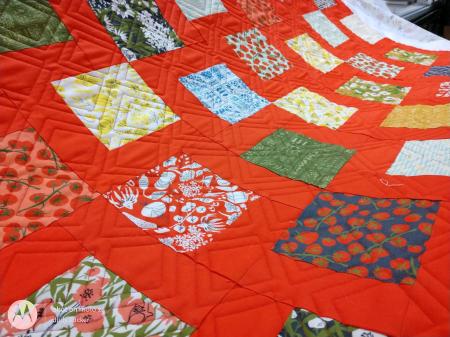
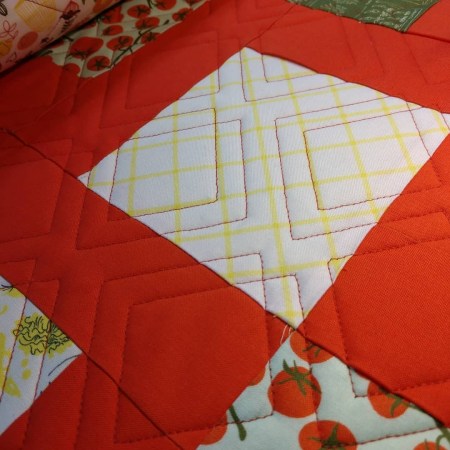
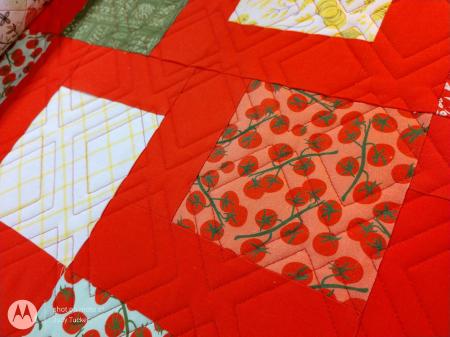
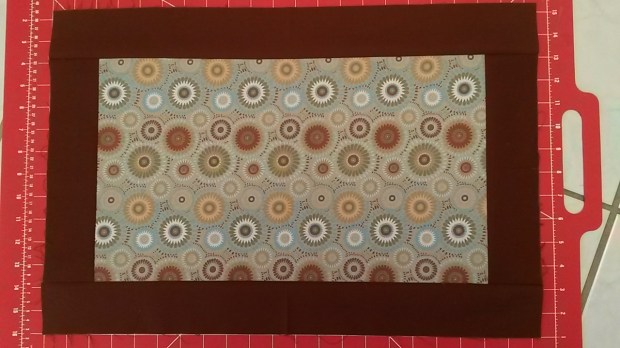
If you want better borders, so they are not flopping in the wind or somehow out of wack, but really hate math and measuring, this is for you. This is the method I have used since I started quilting and still use today. It works for me, give it try and you won’t be disappointed. Any questions, or unsure of any step, PLEASE contact me. I want you to have fun while making a better quilt!

Make sure your quilt top is nicely pressed.

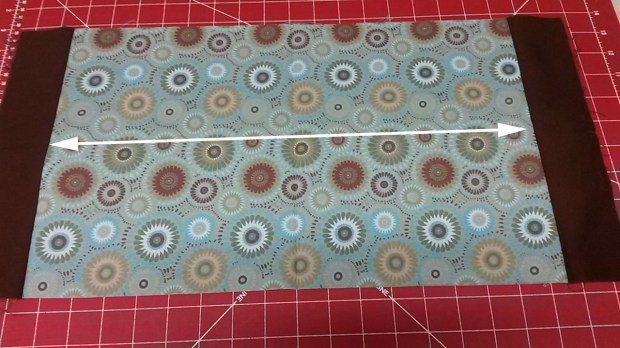
Find center of the quilt top. Do this by folding the ends and marking middles with a pin, iron tap the center, or use a chalk mark.

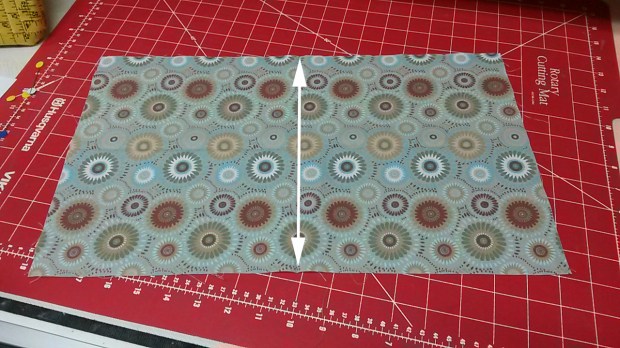
Cut border fabric for the first two sides you will be applying. Make sure you go longer than your quilt top.

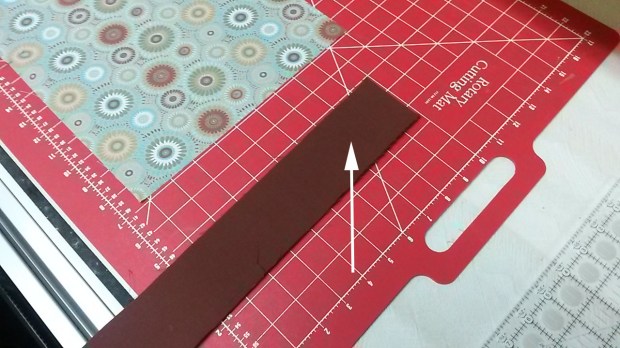
Line up border fabric on the top of each other, and find the centers of these pieces in the same manner. Mark them.

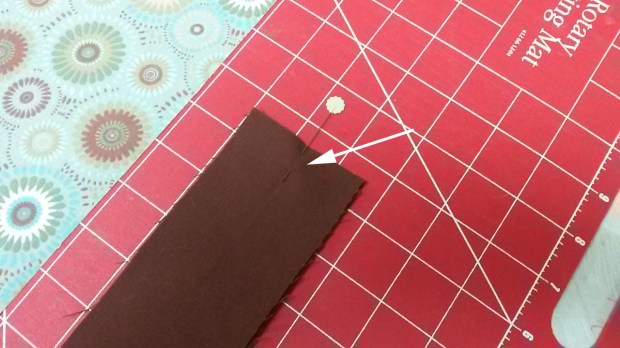
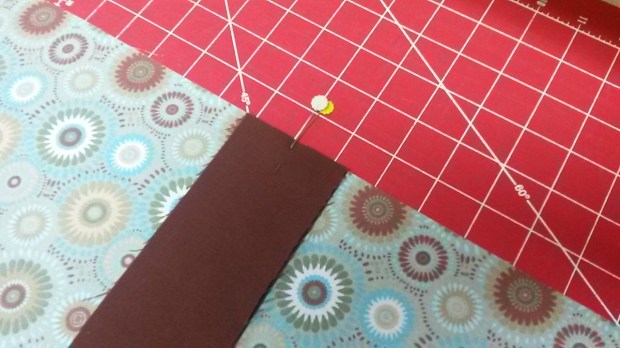
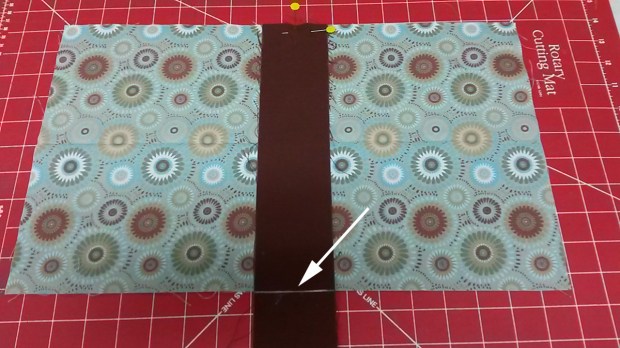
Match the center points of the border with the center of the quilt, pin them together well.

Gently, without pulling, lay the border strips down the middle of the quilt, keeping them all in line. Mark borders with pin, chalk or finger press where the borders meet the end of the quilt.

Trim your borders where marked.

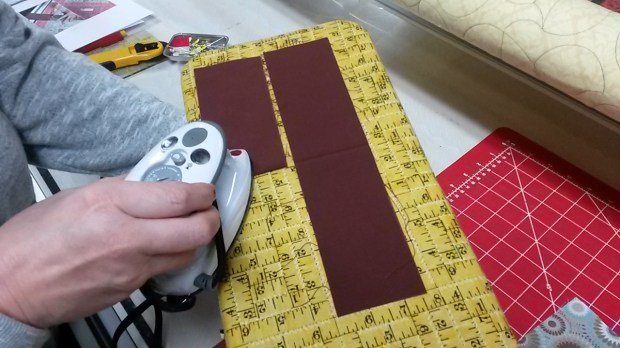
Find the centers of borders by folding in half and iron press center ,this will help with registration marks.

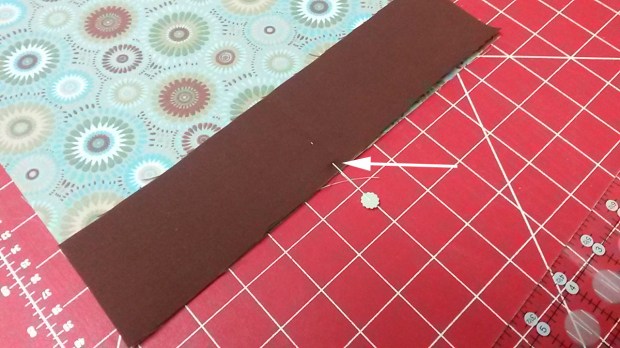
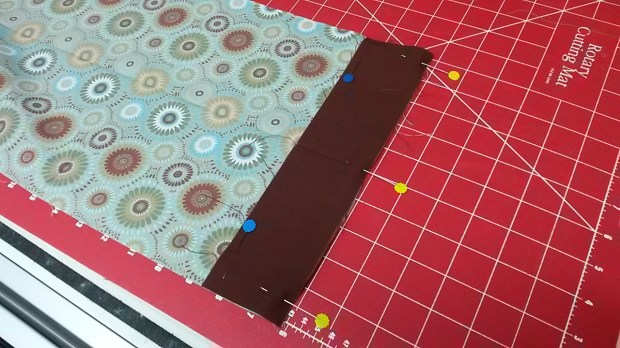
Match centers of borders with center marks on ends of quilt, (PIN) right side together on top of quilt.

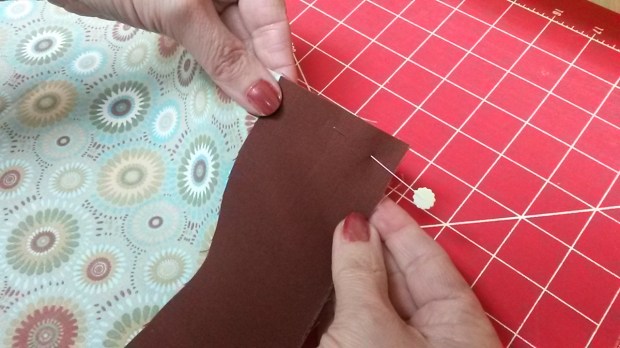
Match ends of borders to end of quilt making sure you have 90 degree angle in corners and pin.

Pin more of the borders on the side making sure they will not shift in sewing. Add more pins to hold border as you sew. Ease in any fabric (if needed) between already pinned points. Now Sew! Do not sew over the pins.

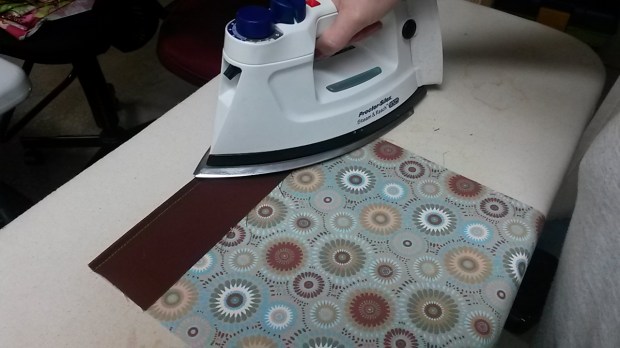
Now that you have your two borders applied, press.

Now find the center again and mark.

Again, find your center on the borders to match to your center on the quilt top. Gently bring across the quilt. Mark the ends where they meet the end of your quilt top and trim.

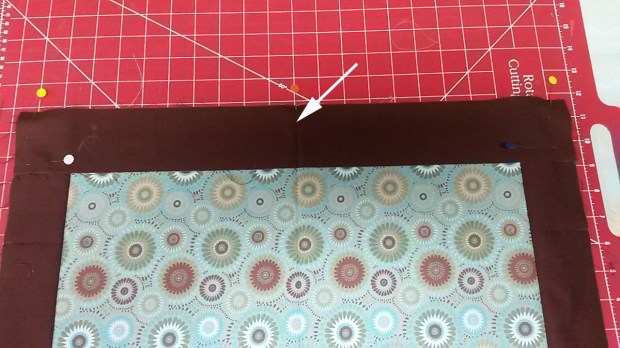
Find your centers again and pin in the same manner as you did the others. (if quilt is large, fold into quarters for borders and quilt) this will help with registration marks.

Finished, square and no trimming needed.

Designed by Beth Helfter, EvaPaige Quilt Designs, “Teal Mini Swap” is an annual event intended to raise awareness of ovarian cancer, funds for Ovarian Research Fund, and give quilters and sewers a fun little swap. In the last five years this has raised approximately $8,500
Iris of Misty Fuse had share the post of this event and immediately I signed up. There was a $15 fee which included you piece of challenge fabric and information about the partner that has been chosen for you to swap with.

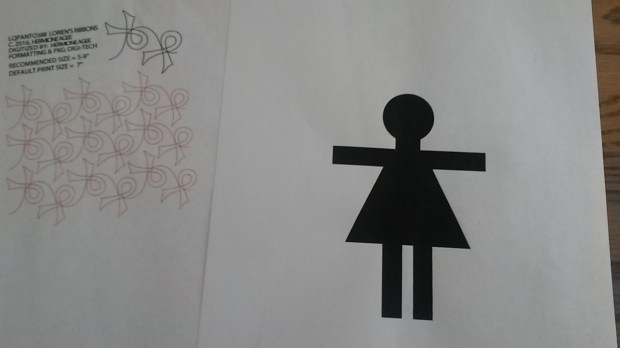
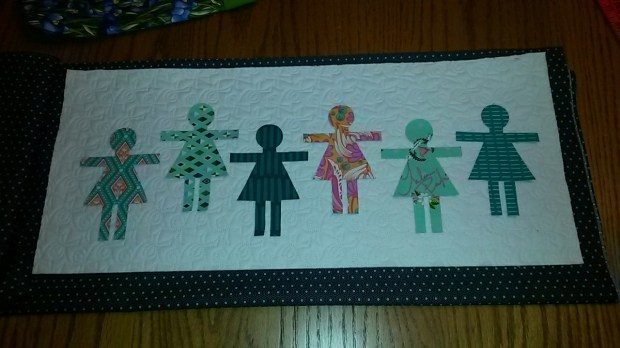
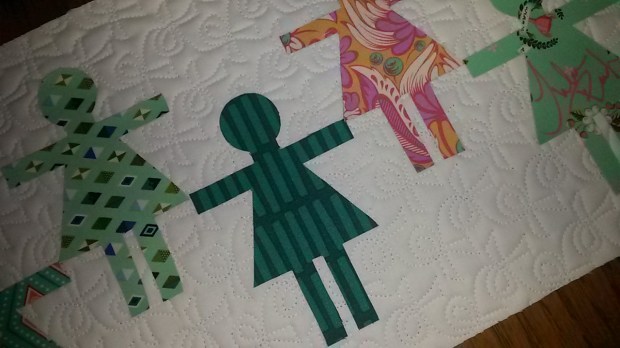
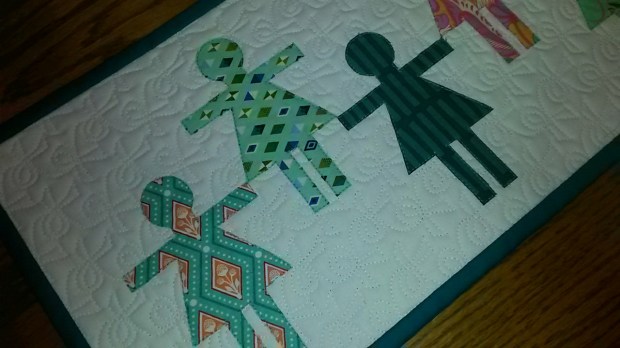
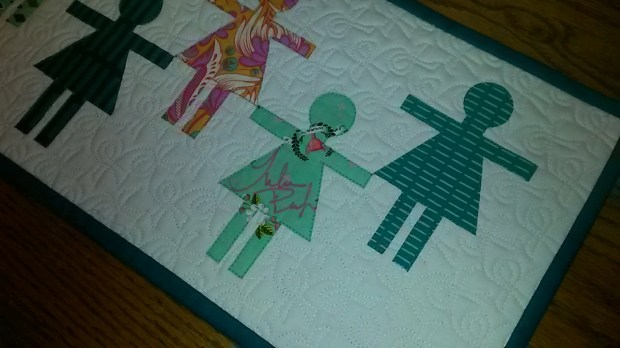
So this is the quilting design for the background and the main focus of the quilt.

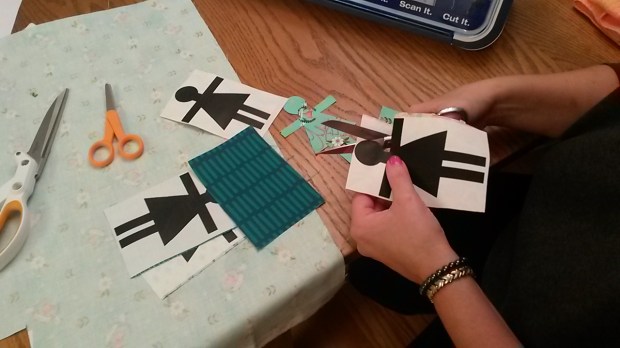
I applied fuseable to the fabrics and cut each one out.

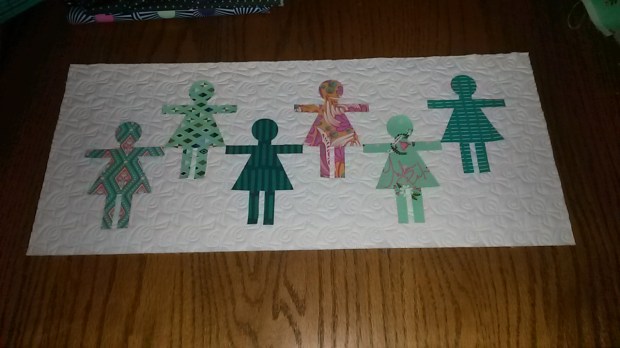
This is the original layout I had planned.

Played a little bit with the orientation.

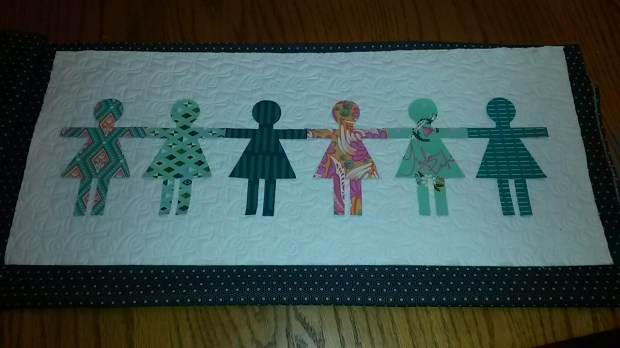
Decided this is what I found best for me. It allowed me to think about quilting the ladies without any gap. Going up one way and continue with out a start and stop going the other direction.

The dark teal stripe was the challenge fabric.

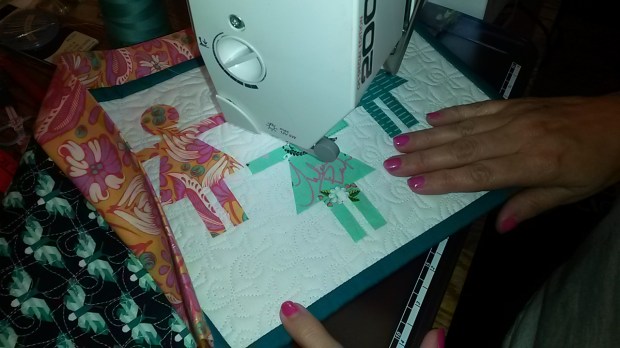
Stitching around in a straight stitch as opposed to a zig zag stitch. Just my preference. Used my Bernina Virtuoso 160.

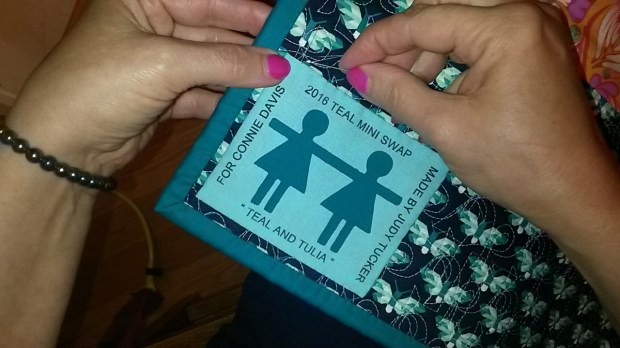
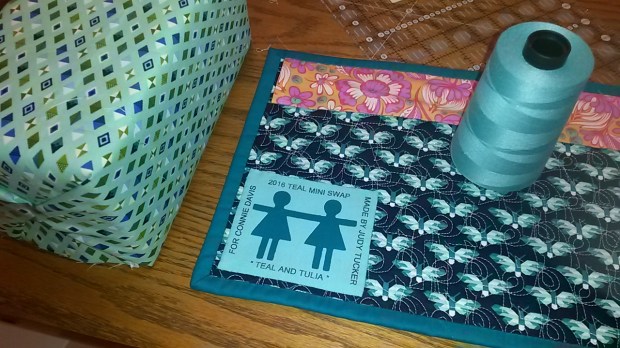
I like to try to carry the design of the front over to the label. Think of it as another element and not just a tag…

The backing fabric is Elizabeth Hartman for Robert Kaufman, and the sleeve Tula Pink. I used Perma Core thread and wrapped a gift in more of Tula Pink fabric I had left from the front.

One was a 5 inch sq. I had in my stash,Tula fabric and challenge fabric.

Two more Tula fabrics. One Tula had signed , and another from my stash!
Here is a tutorial I am offering at this year’s International Quilt Festival Open Studio.


Measure quilt back from edge to edge in the direction where the sleeve will hang. This will be your length. (top) The width will be 9 inches. (bottom)


Place your sleeve right side down. Fold your nine inch edge a ¼ inch in on each side. PRESS. (top) Fold another ¼ of an inch on each side. PRESS. Then machine stitch close to inner edge. (bottom)


Bring the bottom edge up to meet (raw edges) wrong side together. (top) With wrong sides together, sew a ¼ inch seam the length of the sleeve. Begin the seam about ½ inch from the end, backstitch, continue seam to the end, then backstitch. This prevents the tail of the thread from hanging out the end of the sleeve. Press to form a new crease at the folded edge. Baste a large stitch ¼ inch along the new folded edge. (bottom)


Place your hands into the sleeve rotate sleeve to position basted edge on the bottom and the stitched seam on top. (top) Position the two seams over each other. Gently press your top seam open. Press entire sleeve forming two new creased folds. (bottom)

Take sleeve with opened seam side down against quilt backing. Center along quilt back, pin sleeve along pressed edges to the quilt back. The top of the sleeve should be about ½ inch from the top of the quilt.
Hands sew top of sleeve, being careful not to stitch through to the front of the quilt. Then hand sew bottom sleeve again being careful not to stitch through to the front of the quilt.

Hands sew bottom edge of the sleeve sides to the back of the quilt. I recommended that you double stitch or tack the corners.

Remove the basting stitch to give the sleeve the needed “D” shape for proper hanging.
Judy Tucker joins Mary Fons on Quilty to give you step-by-step instructions for doing bias binding on your quilt. This quilt finish allows you to do curved borders more easily because the fabric stretches. Judy tells you more about it in this informative tutorial.
Judy talks about the simple quilt she made at a quilting retreat. In this particular quilt, Judy re-sized every single one of her 300-plus quilt blocks. Learn more about Judy’s process for putting this quilt together.
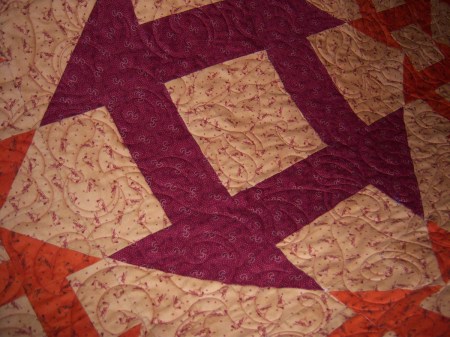
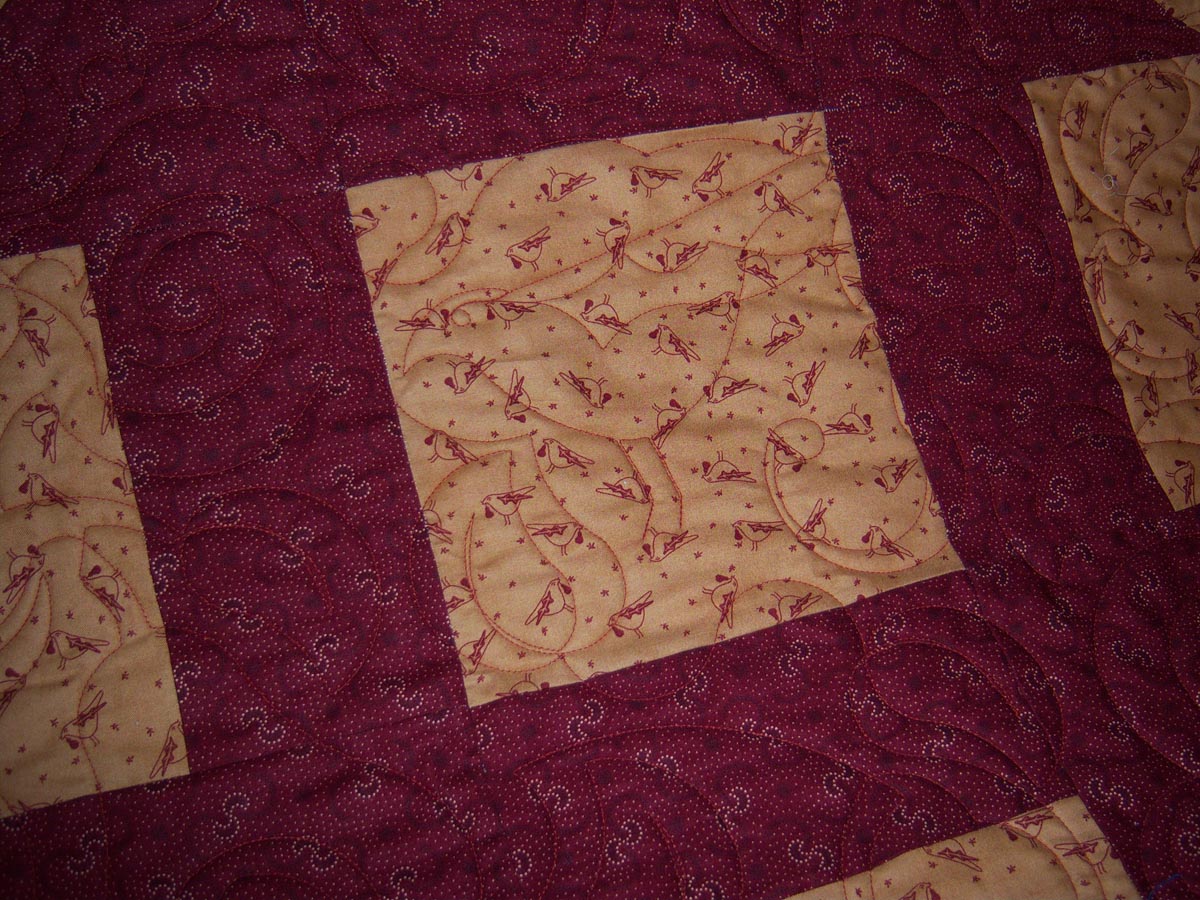
Have you ever had a task that you found to have a brain block on? Maybe mine was temporarily away or just taking a break. My customer and quilt friend, Janice H. had brought me her quilt top to enhance with longarming the right design. She really liked her fabric with the crows and liked the folk feel, this top was giving her.
I looked at many digital designs; okay hundreds. Auditioned various designs including a leaf design, but didn’t want to make the finished quilt too seasonal. Found a design by Debra Geissler and Designs by Deb, that had a great design with a pear but adding a bird would be better for this quilt.
Okay, so if we could just add a crow……hmmmmm. I contacted Deb , sent her a close up of what I was hoping to achieve and 2 days later, DONE.
Deb was open, fast and right on the money with the design.

Happy Quilter = Happy Customer!!!!
I must say, this is the second time I have asked for a tweak, or something special from Deb and she has been a pleasure to work with.
During Open Studio, the audience was amazed with the options Lesley Riley’s Transfer Artist Paper (TAP) gives them. So often it is hard to come up with a label for your quilt, let alone write on one. This paper offers you a wide range of alternatives to add to your already finished work.
My recent quilt that was in the IQF show had a label which I used this product on. Make a ho-hum label into eye-catching.
I was very fortunate to be able to demo and show some people for the first time how to achieve a new look on bindings.
I chose 2 ideas which I often use myself on my own quilts to add interest or maybe because I ran short on fabric but really want to use it in the binding.
So first – Faux Flange Binding.
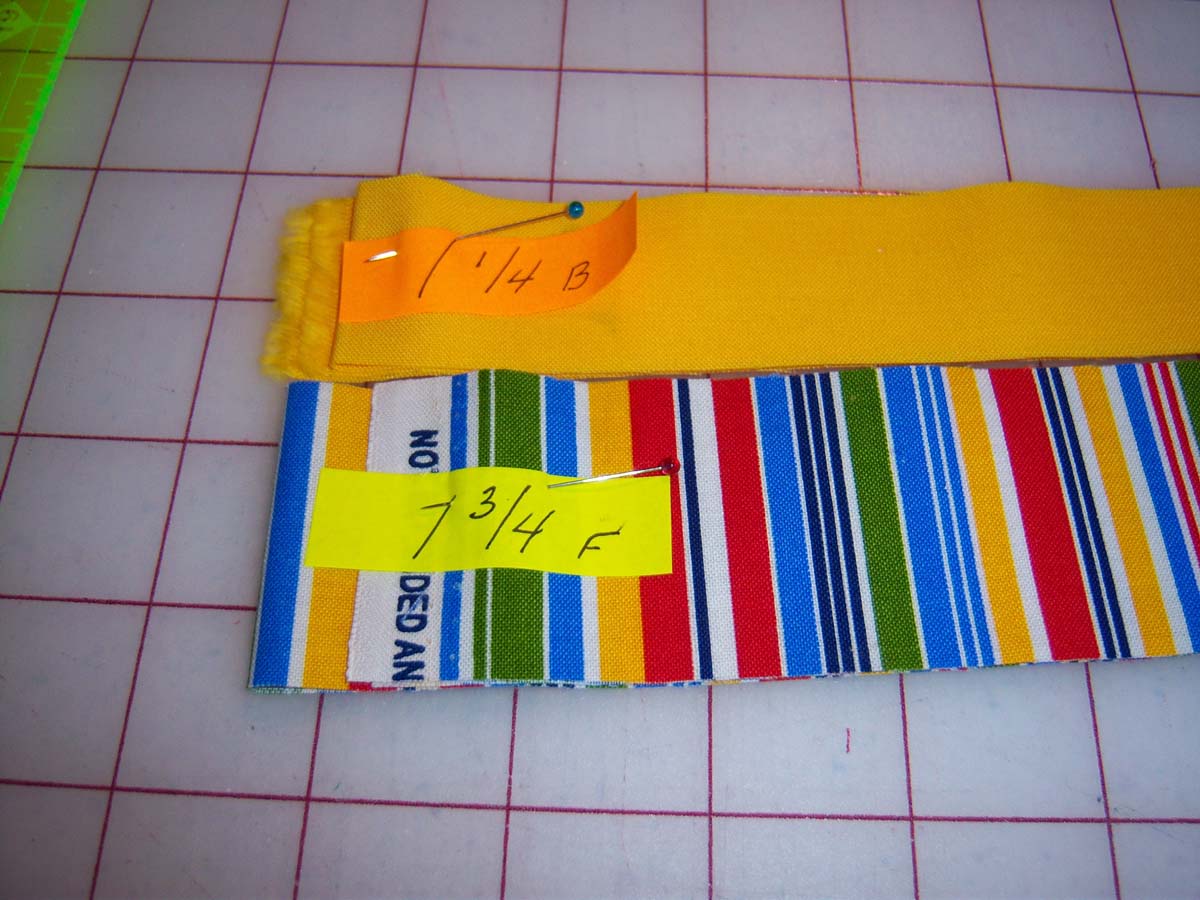
Using a 2 ½ inch binding, Flange cut 1 ¾ in. Outer Binding cut 1 ¼ in.
Now if you choose to have more or less of a Flange you can vary your widths to achieve your look, just remember if you add to one, reduce the other so you still have a complete 2 ½ in binding when sewn.
If you need to join multiple strips to get your length to complete your project, join each, flange strip and then outer binding strip to make two complete units.
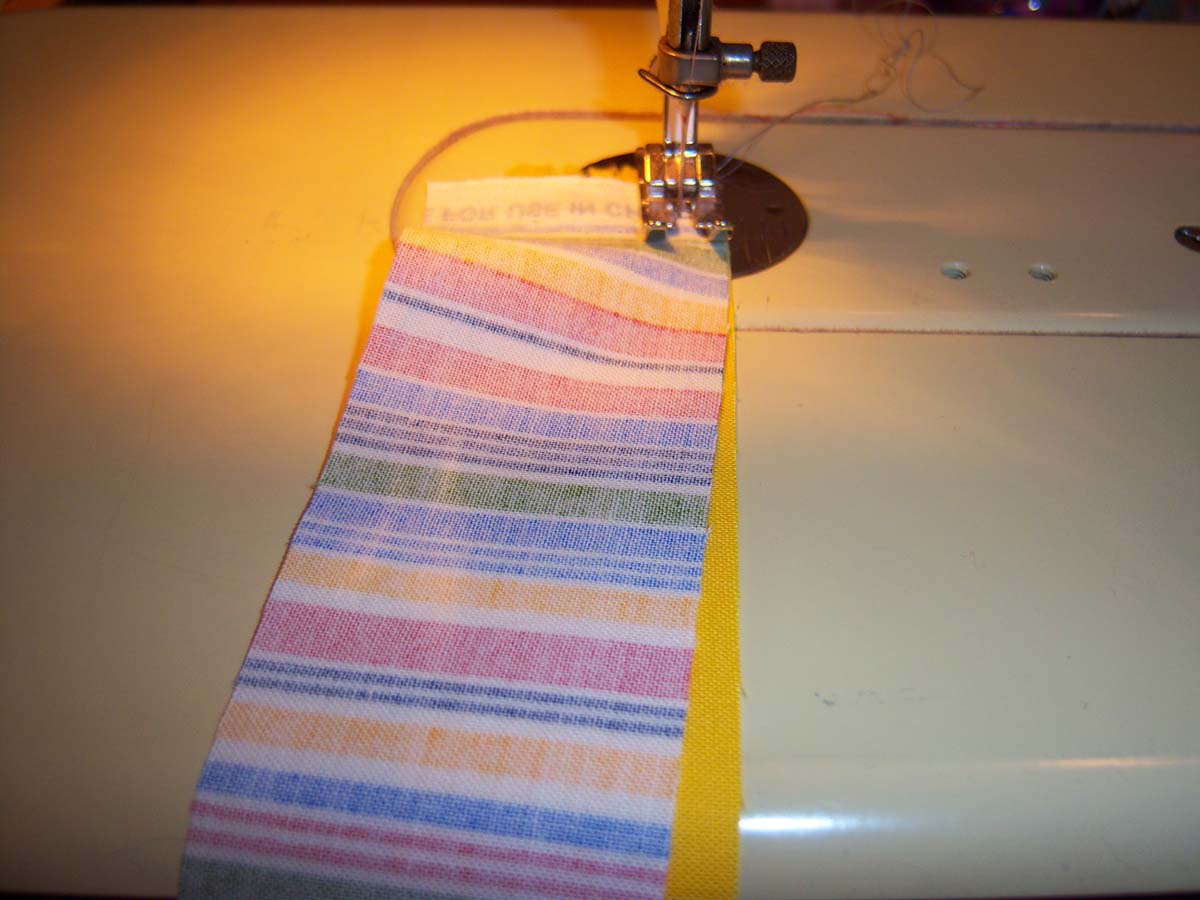
When you have the length you need, join the two strips together with a ¼ in seam to form your 2 ½ in width.
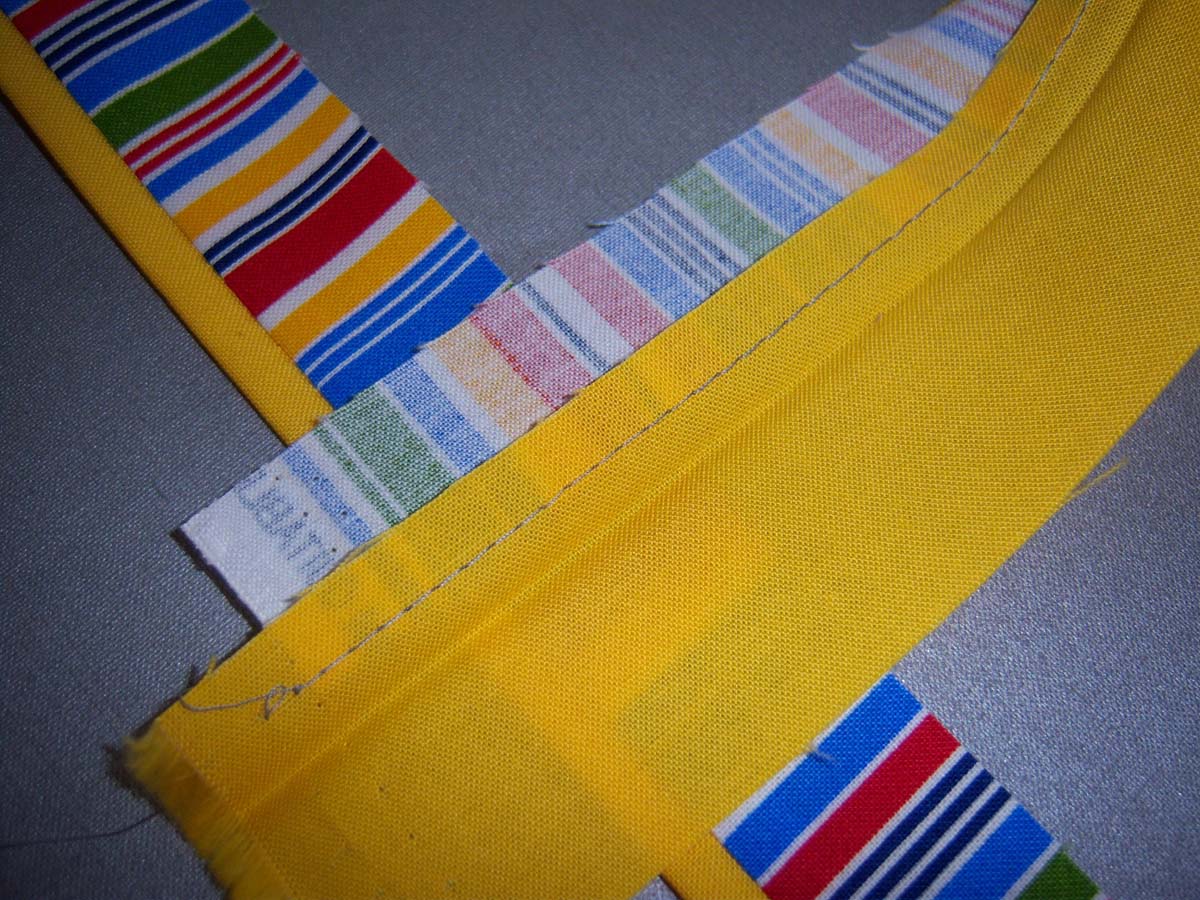
Press to set your seams.
Press seams going to the wider strip.
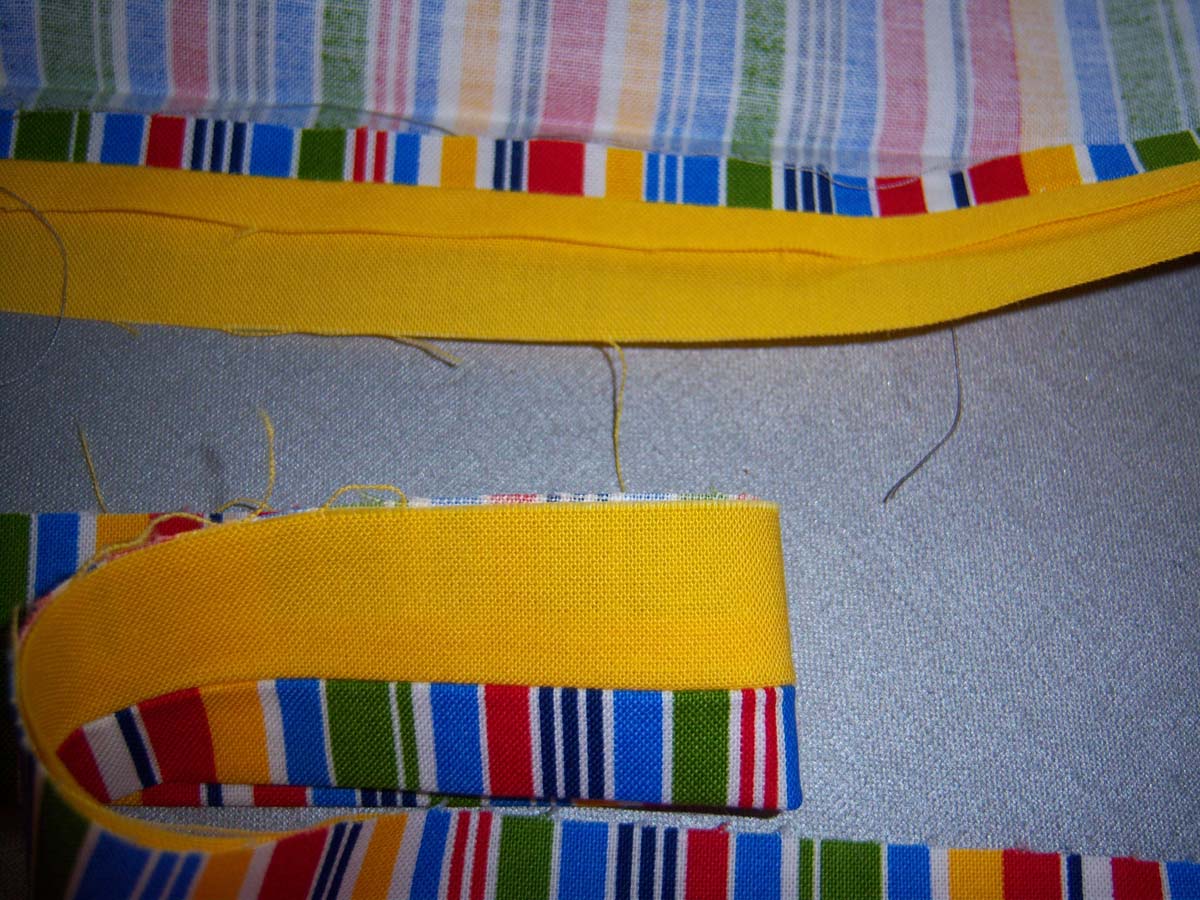
Press in half making sure there is a nice crisp line between the two joined fabrics.
Lay your strip down on the back of your quilt. I like to use a basting stitch when I first start my binding and test to see where it will come over to on the front. I want enough over hang so when I ( SID) Stitch in the Ditch on the front it will hide in the backing not the binding. Test it; you will save yourself time and often a head ache. I continue to sew in the same manner I do with regular bindings and also end them the same manner. Use your method of choice.
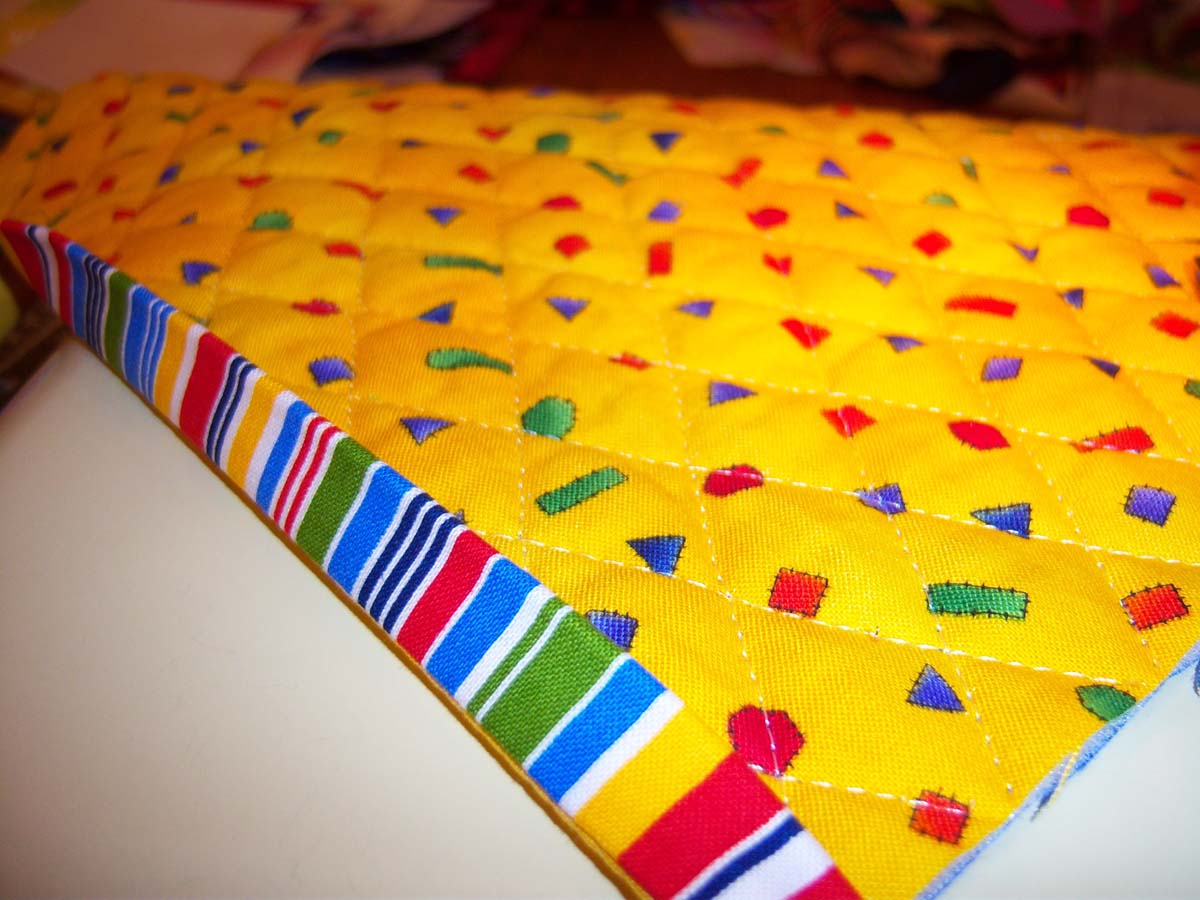
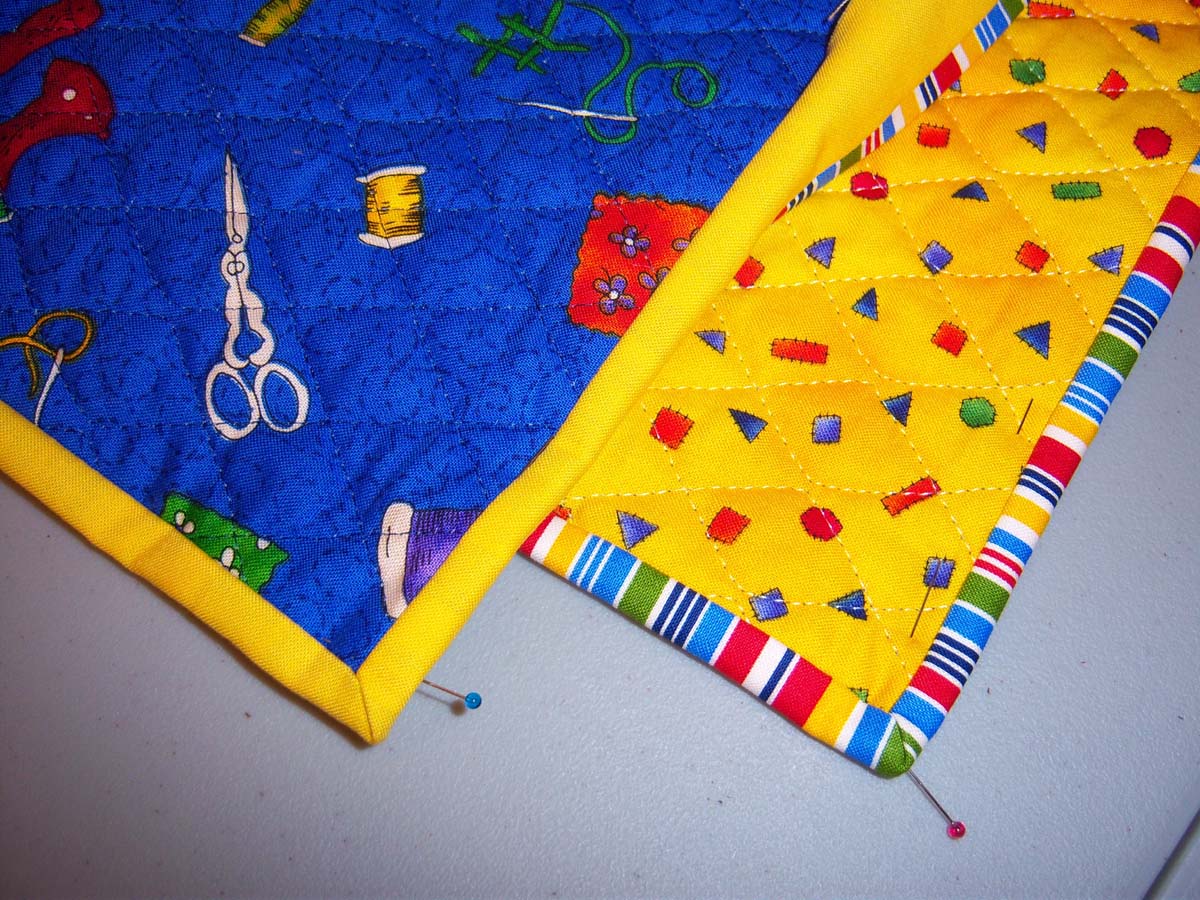
Second technique – 2 Color or 2 Sided Binding.
This makes a 2 ½ inch binding . Cut one strip 2 inches and the opposite strip 1 inch.
Join all your 2″ strips to give you enough length. Join all 1″ strips to give you enough length. * Do this in your method of choice. When you have the desired length for your project join the two strips together with a ¼ in seam.
Press to set seam and then press this seam open being careful not to distort your fabric if it a long strip.
Press in half.
You will lay the narrow 1 ” strip against the quilt on whichever side you have chosen that fabric for.
I do a test baste stitch to make sure the seam on the binding lays right on the edge of my quilt when I wrap it around.
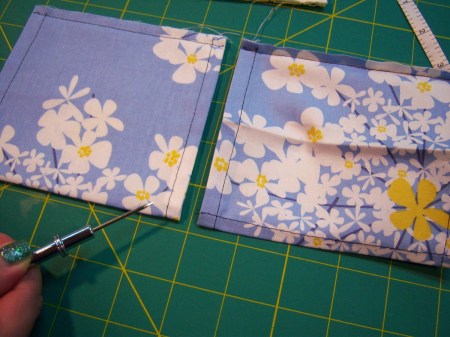
Continue to attach when you are happy with your seam and finish in your desired method.
Hope you gives these a try. If you have any questions shoot me an email.
Well, as the saga continues it took me on turns and tumbles I did not see coming.
I know what colors and styles I like and which I am not so fond of. So I thought.
As the colors played well together and I was open to playing and picking up random pieces to make the happy family, I noticed I liked the way they gave me a sense of contentment. Maybe because I did not stress over matchy matchy ideas or how was I going to live with this piece being slightly off, because it was leaving my hands. It was going to a home where no one would notice these usually tidbits that drive me batty at times.
This little project has taught me much about myself that I did not know. Opened my mind and expanded my palette.
I had been thinking and even discussed recently how my color choices have changed through the years and often with season. Do you look at quilts and colors and think Spring? Winter ? Or whatever the season ?
Do you ever say,” I appreciate the work but just not my colors?” I know I have. May not do that now, knowing how this journey turned out.
Maybe I just pre-judged my color choices. Maybe I needed to explore something within myself. Color heals, art heals, maybe it also helps us grow and explore.
Give colors a chance that you may not have tried before. Entertain them or let them entertain you. See where it takes you.
When you are done you can at least know you have explored, played and used your own hands to create a work love. Or maybe not love …….okay!
Oh and the ending of this story…….it is staying in my home. We have become close friends and I am proud of taking something I turned my nose up at, and now I am proud and admire. The colors make me feel warm and cozy.
I need my new friend, and will cherish how we met.